Alien Spaceship Set: Integrating Futuristic Visual Assets Into Your Creative Workflow
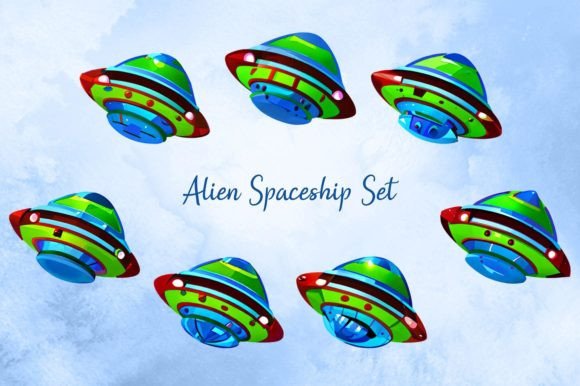
When a project demands visuals that transport audiences beyond the familiar, the right collection of assets becomes the foundation for everything that follows. An Alien Spaceship Set provides a curated library of intricately designed spacecraft illustrations, each one crafted with futuristic detailing and technologies that feel genuinely otherworldly. Rather than starting from scratch, creators can pull from a cohesive visual system where every vessel shares a consistent design language while offering enough variety to serve different narrative or branding purposes. This isn't simply a pack of images—it's a resource that shapes how science fiction concepts move from abstract ideas into finished deliverables.
Understanding where such a set fits within broader creative and commercial processes matters more than simply downloading files and hoping for the best. Whether you're designing a book cover for a self-published novel, building a gaming environment, promoting an upcoming convention, or producing content for a science-focused educational platform, the visual quality of your spacecraft imagery directly influences audience engagement and perceived professionalism. The Alien Spaceship Set functions as both a time-saving mechanism and a quality-control tool, ensuring your projects maintain visual standards without requiring custom illustration work for every asset.
What the Alien Spaceship Set Actually Contains
At its core, this collection delivers multiple spacecraft designs rendered as high-quality digital illustrations. Each piece emphasizes intricate hull geometries, advanced propulsion systems, glowing energy signatures, and surface textures that suggest materials and engineering far beyond current human capabilities. Some designs might evoke scientific plausibility, while others lean into the fantastical—giving you flexibility depending on whether your project prioritizes hard sci-fi realism or imaginative world-building.
The files typically arrive in formats compatible with major design software, including raster formats like PNG or JPEG with transparency where applicable, and in some cases vector formats such as SVG for infinite scalability. Resolution matters enormously for print applications, and a well-prepared set accounts for this by providing assets suitable for everything from social media graphics to large-format banners. Before purchasing or downloading, verify the specific file specifications, licensing terms, and whether the set permits commercial use, modification, or redistribution. These details directly affect integration into client work, merchandise, or published materials.
Planning Your Project Around Visual Asset Requirements
Every creative project begins with planning, and visual assets often become limiting factors if not considered early. When you identify that spacecraft imagery will play a central role—whether for a website hero section, a game's vehicle selection screen, or a series of digital art prints—mapping out exactly what you need prevents last-minute scrambling. Ask yourself how many distinct ships your project requires, what perspectives or angles work best for your layouts, and whether the aesthetic should lean sleek and mysterious or rugged and industrial.
The Alien Spaceship Set can anchor this planning phase because it gives you a concrete inventory of available visuals. Instead of communicating abstract concepts to an illustrator and navigating revision cycles, you can select specific ships from the collection that match your vision. This shifts the planning conversation from "what might we create" to "what will we use," accelerating timelines and reducing uncertainty. For teams, sharing the set during initial brainstorming sessions aligns everyone around a shared visual reference point, making feedback more precise and actionable.
Integration With Design Software and Platforms
Once you have the set, the practical work of integration begins. For graphic designers working in Adobe Photoshop or Affinity Photo, importing high-resolution PNG files onto layered compositions lets you composite spaceships into cosmic backgrounds, promotional posters, or book cover mockups. The key workflow consideration involves matching lighting, color grading, and scale so the ships feel naturally embedded rather than pasted on. You might apply adjustment layers, blend modes, and subtle glows to achieve cohesion between the ship and its environment.
Digital artists using Procreate or Clip Studio Paint can incorporate the ships into larger illustrations, treating them as base elements that receive additional hand-painted details. This hybrid approach preserves the intricate mechanical detailing of the original assets while adding custom atmospheric effects, battle damage, or energy trails that make each composition unique. Video editors working in After Effects or DaVinci Resolve can animate static ship images with keyframed motion, scaling, and opacity shifts to create title sequences, transitions, or looping background visuals for event displays.
Web developers integrating the Alien Spaceship Set into science fiction websites or landing pages need to consider file size optimization without sacrificing visual fidelity. Tools like TinyPNG, Squoosh, or image optimization within build pipelines compress files for fast loading while preserving transparency. Using modern formats like WebP with PNG fallbacks ensures broad browser compatibility. For gaming graphics, engine-specific considerations arise—importing sprites into Unity or Godot may require sprite sheet generation, while Unreal Engine projects benefit from properly configured texture settings for UI elements or 2D game assets.
Workflow Examples Across Different Disciplines
The versatility of a well-designed spacecraft collection becomes apparent when you trace specific workflow paths through various professions and creative contexts.
Self-Published Authors and Book Cover Designers: An author preparing a science fiction novel for independent publication needs a cover that competes visually with traditionally published titles. Working with a cover designer, the author can select several ships from the Alien Spaceship Set that match the story's tone. The designer then composites the chosen vessel with starfields, planetary bodies, and typography, adjusting lighting and color grading to create a unified composition. Because the ship already contains rich mechanical detail, the designer spends time on composition and atmospheric treatment rather than constructing geometry from scratch. The result reaches market faster, often at a lower production cost, without sacrificing the distinctiveness that sells books.
Event and Convention Promoters: Organizers of sci-fi conventions, gaming expos, or space-themed events need promotional materials across multiple formats—posters, social media graphics, website banners, email headers, and printed programs. The set provides a consistent fleet of ships that can appear across all these touchpoints, reinforcing brand recognition. One ship might serve as the hero image on a poster, another appears on speaker announcement graphics, and a third anchors the event website. Consistency across materials builds audience trust and professional credibility, and having a unified set eliminates the mismatched aesthetic that results from sourcing images from disparate sources.
Educators and Science Communicators: Teachers, professors, and content creators developing materials about astronomy, space exploration, or physics often need visuals that capture student attention while illustrating conceptual ideas. A Alien Spaceship Set provides engaging imagery for slide decks, handouts, or video lessons without requiring students to suspend disbelief around recognizable real-world spacecraft. When the goal is discussing theoretical propulsion, habitable exoplanets, or the possibilities of extraterrestrial intelligence, having compelling visuals keeps learners engaged and provides concrete anchors for abstract discussions.
Game Developers and Hobbyists: Indie game studios and solo developers building space shooters, strategy games, or visual novels benefit from pre-made ship assets that can populate their game worlds during prototyping or even final production. Implementing the ships as UI elements for vehicle selection screens, as background decorations in orbital scenes, or as base sprites that receive additional animation layers speeds development. The consistency of the set means ships designed by the same artist will share proportional logic and detailing density, avoiding the jarring style clashes that occur when mixing assets from multiple creators.
Organizing and Managing Digital Assets for Long-Term Use
Effective asset management determines whether a creative investment pays dividends over multiple projects or becomes lost in a disorganized folder structure. When you acquire the Alien Spaceship Set, establish a naming convention and folder hierarchy immediately. Sort files by ship designation if the set includes named vessels, by angle or perspective (front view, side profile, three-quarter angle), or by intended use case (web-optimized, print-ready, source files). Adding metadata tags through your operating system or a digital asset management tool makes future searches faster.
If you modify the original images—by recoloring hulls, adding weathering effects, or extracting silhouettes for logo design—save these derivatives alongside the originals with clear versioning. A consistent suffix like "_recolor_01" or "_weathered" prevents confusion when you return to the folder months later. For teams, storing assets on shared cloud drives with read-only permissions for original files and separate working folders for modified versions protects the integrity of the source material while allowing creative exploration.
Quality Control and Consistency Across Deliverables
One of the less obvious advantages of working with a unified asset set involves quality assurance. When every ship in the collection comes from the same creative source, visual consistency across your deliverables becomes far easier to maintain. The lighting logic, material rendering, and level of detail remain uniform, so a spacecraft appearing on a website header won't clash with a different ship from the same set used on a promotional flyer. This cohesion signals attention to detail and professionalism, qualities that audiences and clients notice even when they can't articulate exactly why something feels polished.
Print applications introduce additional quality considerations. Before sending designs to a printer, confirm that the ship images you've placed meet resolution requirements at the intended output dimensions. A 300 DPI standard for print means a ship that spans 10 inches in your layout needs at least 3000 pixels across. If the source files don't stretch that far without interpolation, consider whether the design can accommodate a smaller ship or whether vector alternatives exist within the set. Testing prints with small runs before committing to large quantities catches issues that screen viewing masks.
Compatibility With Broader Creative Ecosystem
The Alien Spaceship Set rarely functions in isolation. It interacts with other resources and decisions throughout a project. Background imagery—whether NASA photography, procedurally generated nebula art, or custom painted environments—sets the context into which the ships appear. Typography choices for titles, UI labels, or book titles must complement the ship designs rather than fight them for attention. Color palettes drawn from the ships themselves can influence branding decisions, social media template designs, and even merchandise colorways.
When working with clients or collaborators, sharing the set early allows them to understand the visual direction before expensive commitments occur. A client who approves a specific ship for their project has made a concrete decision, reducing the likelihood of subjective feedback loops that delay timelines. Presenting three curated options from the set, each with a brief rationale for why it suits the project, demonstrates both creative judgment and respect for client input.
Adapting the Set for Unexpected Use Cases
Beyond the obvious applications, creative professionals often discover secondary uses that extend the value of the purchase. Ship silhouettes extracted from the illustrations can become elegant icons for app navigation, website section dividers, or embroidered patches for event merchandise. Detailed hull close-ups cropped from larger images provide texture backgrounds for panel headers at conventions or chapter openers in print publications. The glowing engine elements might inspire a color grading preset applied across a video project's entire timeline.
The key to these adaptations lies in treating the Alien Spaceship Set as raw material rather than finished product. Small modifications—desaturating, applying duotone treatments, or converting to line art—transform recognizable spacecraft into design elements that serve purposes never envisioned by the original creator. This flexibility explains why investing in quality assets typically outperforms chasing free resources that lack the resolution, detail, or stylistic coherence required for professional output.
As your creative projects evolve and technology shifts—whether into augmented reality applications, motion graphics for new platforms, or print formats you haven't yet explored—having a library of well-organized, high-quality spacecraft visuals positions you to adapt quickly. The time saved by pulling from an existing collection rather than starting each project with a blank canvas compounds across months and years of creative work, making the Alien Spaceship Set not just a one-time purchase but a persistent component of your creative infrastructure.